
Prime Minister Narendra Modi has five key aspects to his style of leading -- total command over bureaucracy, direct approval on every decision, flexible approach to issues, importance of communication and adept at repackaging schemes, says A K Bhattacharya.

The success of the government will depend substantially on the quality of its team of key ministers, officials and advisors

The next prime minister must ensure that the mistakes made by Manmohan Singh during his tenure are not repeated, notes A K Bhattacharya.

Shastri took the first big step to transform India's agriculture, the benefits of which his successors reaped in plenty, says A K Bhattacharya.

Indian elections are won and lost on 'negative' imageries and campaigns - but not certainly on 'negativity' as a political trait and electoral creed, asserts N Sathiya Moorthy.

Mamata Banerjee was on Friday sworn in as the chief minister of West Bengal for the second consecutive time, heading a 42-member ministry.
'The EC is a sacred institution.' 'In the last few years, more than once, we have found the EC bending over backwards to accommodate the government.'

Fali Nariman, one of India's best-known lawyers, tells Aditi Phadnis that plurality of political opinion is the only way to counter intolerance
Prime Minister Narendra Modi is being accused of wrong things. His main problem is his view of himself, says T C A Srinivasa-Raghavan
'There is a compulsion to look hard, decisive, and risk-taking; start something; and then conclude it in a way you can claim victory.' 'That is not such an easy option against China,' notes Shekhar Gupta.
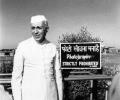
'His contributions in setting up transparent precedents of governance are still basically intact despite the cynicism of several of his successors,' notes Jamini Bhagwati.

From being the hand-picked choice of Sonia Gandhi as Andhra Pradesh chief minister to sitting on a dharna in Delhi against division of the state, Nallari Kiran Kumar Reddy has turned from a Congress regional leader to a disgruntled rebel in his nearly 39-month tumultuous tenure.

Pranab Mukherjee's book The Dramatic Decade: The Indira Gandhi Years takes the readers through the economic and social unrest of the period leading up to the emergency, rise and fall of leaders, many splits within the Congress, while promising to offer more in the next two volumes of the trilogy, says Nivedita Mookerji.
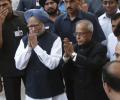
Manmohan Singh, reveals the former President, was keen that either P Chidambaram or Montek Singh Ahluwalia be the finance minister.

20 years ago this day, May 11, 1998, India conducted its second nuclear test at Pokharan in Rajasthan. In a fascinating interview on Rediff.com, K Subrahmanyam revealed how Indian PMs reacted to nuclear ambitions.

Repromulgation is a perennial malaise; and judges must clarify -- indeed, revisit -- the rules that govern this practice, argues Shubhankar Dam.

The prime minister had violated the model code of conduct by holding a 'roadshow' after voting in the Gujarat assembly polls, Congress chief spokesperson Randeep Singh Surjewala alleged.
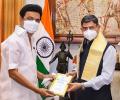
The DMK feels its genuine gestures have had no bearing on the governor's politico-administrative conduct, which is 'more political and politicised than administrative and Constitutional', observes N Sathiya Moorthy.
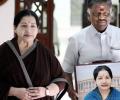
'Going by his political conduct over the past 15 years since first becoming chief minister, he has made enough enemies among equals as friends and followers.' 'They could gang up and that could mean a lot for AIADMK politics to handle,' says N Sathiya Moorthy.

A new West Asia is emerging and India must engage at the highest level and help shape this change, says Saeed Naqvi

From Sri Lanka's most popular political family to its most despised -- going by the voices on the streets calling for the Rajapaksas' ouster -- what went wrong for the clan? Veteran Sri Lanka watcher N Sathiya Moorthy offers an insight.
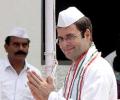
'Sonia Gandhi can't rejuvenate the party, her heir is fodder for stand-up comedians, and nobody in the Congress has the guts to question the Nehru-Gandhis.'
'The cooperation of Yakub with the investigating agencies after he was picked up informally in Kathmandu and his role in persuading some other members of the family to come out of Pakistan and surrender constitute, in my view, a strong mitigating circumstance to be taken into consideration while considering whether the death penalty should be implemented,' B Raman had written in August 2007.

'The CBI should be bifurcated and the CBI's charter should be restricted to anti-corruption cases.'
'The investigation of major criminal cases having national and international implications, and national crimes spread over more than one state may be entrusted to a new national crime bureau,' recommends Dr Madhav Godbole, the former home secretary.

Rediff.com gives you a look at newbies in the Council of Ministers

The Modi-Shah definition of secularism is, India is a confident, resurgent Hindu, and therefore secular, country.

"Who will be his men?" a distinguished official close to the prime minister asked. Frankly, nobody has an idea. Hardly seven weeks are left for a regime change, but the idea of Narendra Modi on Raisina Hill looks abnormal, if not unreal. Rediff.com's Sheela Bhatt captures the uncertain mood in the capital's bureaucracy ahead of the largest democratic transfer of power in the world.

Dr Raghuram Rajan's departure holds lessons for all, be it sections of the media, politicians or the people themselves. We need to learn how to value and retain talent. At the same time the talented must realise that talent alone does not ensure the top job, says Sanjeev Nayyar.

'What the government should do to create jobs is to help revive the MSME sector.' 'This sector gives employment to lakhs of people.' 'The MSME sector provides more employment than the big industries.' 'So, what should be done immediately is to revive the MSME sector.'
Naresh Chandra, former cabinet secretary, diplomat and well-known strategic thinker, tries to explain what the Modi government is up to and assesses what will work and what may not work and why. He spoke to Sheela Bhatt/Rediff.com, also, on diplomatic issues.
'People have a certain perception about my political leanings -- and rightly so.' 'But I am an actor first, and then an activist.' 'And I am not an accidental actor.' 'There was no way I was going to be dishonest with my acting,' Anupam Kher tells Veenu Sandhu.

Dabhol's assets will be demerged into the power plant and the LNG terminal.

'This is not a Sanjay Baru or Natwar Singh type of book. It's not a memoir. It's not a book to reveal conversations, real or imaginary. This is not a book to position myself at the centre of the world.' Jairam Ramesh on his stint as environment minister.

'The National Conference and the Peoples Democratic Party, as recent events suggest, are quite content as New Delhi's collaborators rather than trying to be true representatives of the Kashmiri people,' says Athar Parvaiz.
'In being dismissive of Naveen, his colleagues showed incredible naivety.' 'On the few occasions that he put his foot down, the overconfident party leaders, who believed they were using him and not the other way around, failed to read the signs of what was to come.'

'It is imperative to restore the dignity and authority of the services chiefs. Erosion of this has resulted in lowering of service efficiency. It is also time to end the practice of taking seniority as the sole criterion for appointing chiefs.'

Secretary general of CBCI Bishop Theodore Mascarenhas on what he doesn't like about the new education policy.

'The consolation is that in recent years, the focus at the time of the anniversary has been increasingly shifting from Indira Gandhi's assassination to the plight of the thousands of innocent Sikhs who had been killed in retaliation,' Manoj Mitta, co-author of When a Tree Shook Delhi: The 1984 Carnage and its Aftermath, tells Prasanna D Zore/Rediff.com.

Amit Shah is the man of the moment. The architect of the BJP's stunning transformation in the Hindi heartland during the Lok Sabha elections is all set to emerge as the CEO of Modi's political dreams and the Rashtriya Swayamsevak Sangh's cultural passion, says Sheela Bhatt.

Prime Minister Manmohan Singh on Friday disagreed with those in the Congress who were dismissive of the challenge posed by Narendra Modi but asserted that the party would approach the 2014 Lok Sabha polls with self-confidence, irrespective of the results of the just concluded elections in five states.
